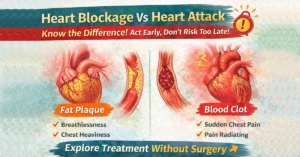
Heart Blockage Vs Heart Attack: Know the Difference (And Don’t Wait Until It’s Too Late)
Many patients walk into my OPD worried and confused.Some panic the moment they hear the words “heart blockage.”Others ask, “Doctor,


Sugar is everywhere.
In your morning tea. In biscuits. In packaged snacks. In fruit juices. Even in so-called “healthy” breakfast cereals.
Yet most people ask me only one question:
“Doctor, how much sugar is actually too much?”
The problem is that we don’t see sugar clearly. Food labels talk in grams, while our kitchens talk in teaspoons. Once you connect the two, the picture becomes very clear—and often shocking.
Let’s simplify this.
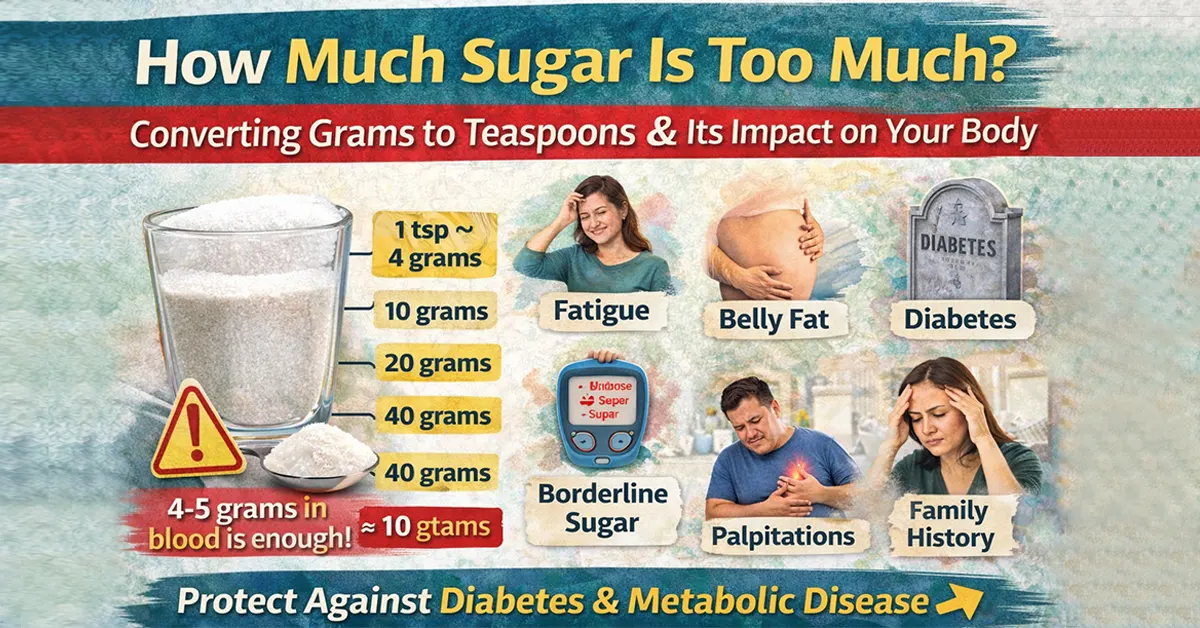
1 teaspoon of sugar ≈ 4 grams
10 grams = 2.5 teaspoons
20 grams = 5 teaspoons
40 grams = 10 teaspoons
The World Health Organization (WHO) recommends limiting added sugar to about 25 grams per day—that’s roughly 6 teaspoons.
In real life, many Indians consume two to three times this amount daily, often without realising it.
This surprises many patients.
Your body can manufacture its own sugar through a process called gluconeogenesis. The liver converts:
Stored glycogen
Proteins
Fats
into glucose as needed.
This means refined sugar is not essential for survival. Even if you stop eating sugar completely, your body can still supply glucose for:
Brain function
Muscle movement
Organ activity
Sugar is a convenience—not a necessity.
An average adult has about 5 litres of blood.
At normal fasting levels (around 90 mg/dL), the total amount of sugar circulating in your entire bloodstream is only 4–5 grams.
That’s roughly 1 teaspoon of sugar.
Your body functions perfectly with just one teaspoon of sugar in circulation at any given time.
Now think about what happens when you drink a beverage containing 8–10 teaspoons at once.
Once sugar enters the bloodstream, different organs respond:
Brain: Uses glucose steadily, not in spikes
Muscles: Burn glucose during movement and exercise
Liver: Stores excess glucose as glycogen (limited capacity)
Pancreas: Releases insulin to control blood sugar
Fat cells: Convert excess sugar into stored fat
The system works beautifully—until overload becomes routine.
Repeated sugar spikes force the pancreas to release insulin again and again.
Over time:
Cells stop responding efficiently to insulin
Insulin resistance develops
Blood sugar stays high for longer
Insulin resistance is the root cause of:
Type 2 diabetes
Obesity
Fatty liver
PCOS
High blood pressure
Heart disease
If this continues unchecked, the pancreas becomes exhausted, leading to chronic high blood sugar.
Animals like lions, cows, goats, deer, and elephants do not consume refined sugar.
Yet they maintain stable metabolic health throughout life.
Historically, humans also lived without processed sugar. The sharp rise in diabetes closely mirrors the increase in refined sugar consumption, not natural food intake.
If your bloodstream needs only 1 teaspoon at a time, consuming 8–10 teaspoons in one drink or dessert clearly overwhelms the system.
Early warning signs often include:
Fatigue after meals
Frequent hunger
Belly fat
Sweet cravings
Borderline blood sugar levels
Family history of diabetes
These are signals, not coincidences.
Yes—insulin resistance can be reversed, especially in the early and middle stages.
This is where structured, root-cause-based care becomes important. Many patients today actively explore Ayurvedic treatment for diabetes because it focuses on correcting metabolism, digestion, lifestyle, and insulin sensitivity—not just suppressing sugar numbers.
At Madhavbaug Clinics and Hospitals, we follow a scientifically designed, non-invasive, Ayurvedic-integrated model aimed at:
Reducing insulin resistance
Improving pancreatic efficiency
Supporting liver metabolism
Correcting weight and lipid imbalance
Protecting long-term heart health
This approach complements modern type 2 diabetes treatment by addressing why sugar rises—not just how to lower it temporarily.
Thousands of patients have shown improvement in:
HbA1c
Weight
Blood pressure
Lipid profile
Energy levels and stamina
Read food labels carefully
Convert grams to teaspoons mentally
Reduce sugary drinks and packaged foods
Eat home-cooked, balanced meals
Move your body daily
Sleep on time
Monitor sugar levels regularly
Small daily corrections prevent big future complications.
Sugar doesn’t harm you overnight.
It harms you quietly, daily, and consistently.
Understand how much you consume. Respect how little your body actually needs.
Correct early—and you can prevent or reverse disease before medication becomes lifelong.
A Glucose Tolerance Test (GTT) evaluates how efficiently your body processes sugar after consuming a measured glucose solution. In people with diabetes or prediabetes, the GTT often remains positive due to underlying insulin resistance.
At Madhavbaug, our diabetes reversal approach focuses on addressing this root cause. Through structured, non-invasive Ayurvedic protocols aimed at reducing insulin resistance, many patients experience improved sugar metabolism—and over time, some even achieve GTT-negative results under medical supervision.


Many patients walk into my OPD worried and confused.Some panic the moment they hear the words “heart blockage.”Others ask, “Doctor,

Ayurveda Transformed Life After Heart Attack — यह रियल रिकवरी स्टोरी दिखाती है कि सही समय पर medical guidance, lifestyle